 By:
By: Most “personalized learning” systems aren’t actually personal.
They’re calibrated.
They adjust difficulty.
They recommend the next worksheet.
They change pacing.
But they rarely change meaning.
And meaning is what drives persistence.
The Personalization Illusion
Over the last decade, I’ve helped architect adaptive engines powered by knowledge graphs, LLMs, and fine-grained mastery signals across multiple K–12 platforms.
In almost every case, personalization initially meant:
- Adjusting difficulty up or down
- Unlocking the “next” content chunk
- Recommending remediation
That’s useful. But it’s not transformation.
Difficulty adjustment is not personalization. It’s calibration.
If two students are both solving fraction problems - one slightly harder than the other - they’re still walking the same path. One is just walking uphill.
The structure of the journey hasn’t changed.
And structure is where motivation lives.
What Game-Based Learning Reveals
Before leading AI-driven product teams, I built commercial games and multiplayer AI systems. In games, something different happens.
Players persist not because the math is easier.
They persist because:
- Stakes matter
- Identity matters
- The world responds
When we began designing quest-based learning environments at Odeum, we saw this firsthand .
Students would push through challenge levels that were objectively harder than traditional assignments. Not because the content was simplified — but because the effort lived inside a narrative arc.
They weren’t “completing exercises.”
They were:
- Restoring a village
- Unlocking a hidden path
- Earning trust from a character
The cognitive load didn’t disappear.
The meaning changed.
And meaning reshapes effort.
Games Are Natural Signal Engines
There’s another structural advantage in narrative-driven systems.
Games generate mastery signals organically.
In traditional systems, we interrupt learning to measure it:
Take this quiz.
Submit this worksheet.
Prove you know it.
In well-designed games, signal emerges from action:
- How long did the learner persist?
- What strategies did they try?
- Where did they hesitate?
- Which choices did they make under constraint?
This telemetry allows AI systems to infer mastery patterns without breaking flow.
And that opens a door.
If we can infer skill from behavior inside a narrative world, we can begin to adapt not just difficulty — but trajectory.
Why AI Makes Narrative Personalization Possible Now
For years, branching narratives were expensive and brittle.
You could write a few forks. But not many.
Now we can:
- Dynamically branch quest arcs
- Modify character responses based on learner behavior
- Adjust stakes based on inferred mastery
- Restructure pathways in real time
Not by random generation.
By grounding narrative shifts in skill graphs and mastery signals.
This is where AI belongs.
Not as a chatbot layered on top of weak structure.
Not as a dashboard filled with confidence scores.
But as invisible infrastructure shaping the learner’s path through a coherent world.
Personalization Should Reshape the Path
Most adaptive systems personalize the problem set.
Fewer personalize the journey.
Imagine two learners struggling with multi-step reasoning.
In a traditional adaptive model:
- Both get more scaffolded problems.
In a narrative model:
- One might enter a strategic planning quest requiring structured sequencing.
- Another might take on a resource-management arc that strengthens working memory under constraint.
Same underlying skill.
Different narrative pathway.
Different identity formation.
That matters.
Because learners don’t just internalize content.
They internalize who they are in relation to challenge.
A Systems View
From teaching Kindergarten in Taiwan to leading AI architecture across K-12 portfolios, one pattern has remained clear:
Classrooms are live systems.
Momentum is fragile.
Identity is social.
Motivation is contextual.
If personalization ignores those realities, it becomes mechanical.
Narrative is not decoration.
It is infrastructure for motivation.
It shapes:
- Why a learner tries
- How long they persist
- What failure means
- Whether progress feels earned
AI gives us the tools to adapt content.
But narrative gives us the structure to adapt meaning.
And meaning is the missing layer.
---
We don’t need more personalized worksheets.
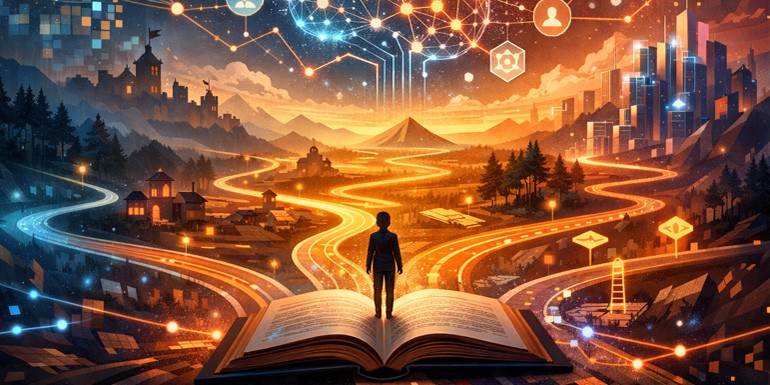
We need adaptive journeys.
The next generation of learning systems won’t just ask:
What problem should this student see next?
They will ask:
What path should this learner walk?
That shift — from content calibration to journey design — is where personalization becomes transformative.
And we’re only beginning to build toward it.